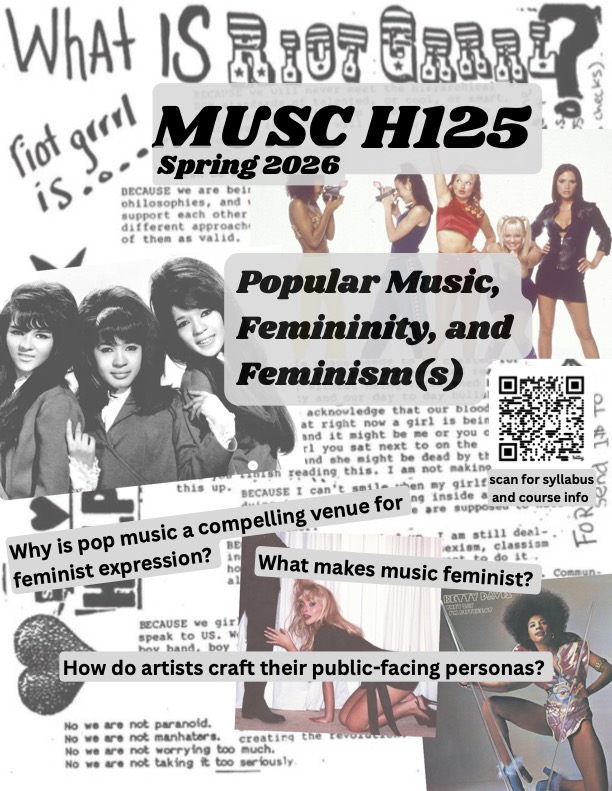
The term “girl power” first appeared in 1991 when the girl punk group Bikini Kill created the phrase, mashing together two words and concepts that were seemingly incongruous: “girl” and “power” of any kind. As cultural critic Sophie Gilbert notes, by the year 1997, the Spice Girls, the massively popular girl group, had coopted the phrase, vacating it of any transgressive, activist meaning. Instead, the term was a vacuous, empty container, a sign of the postfeminist wave sweeping workplaces, homes, and culture. This example begs the question: why is music (especially popular music) the venue of choice for so many different iterations of feminist expression? What makes music feminist? How does one musical context for the term “girl power” lead to such vastly different applications and understandings of the term? This course interrogates such questions and the broader discourse surrounding feminist musicology. By taking an approach that is intentionally non-chronological and inclusive of all musical genres, this course places in conversation a variety of repertoires, scholars, and practitioners to better understand how questions of music, femininity, and feminism are imbricated in larger matrices of racial, socioeconomic, and gender identity; political economies; and other forms of power.
- Teacher: Allison Brooks-Conrad