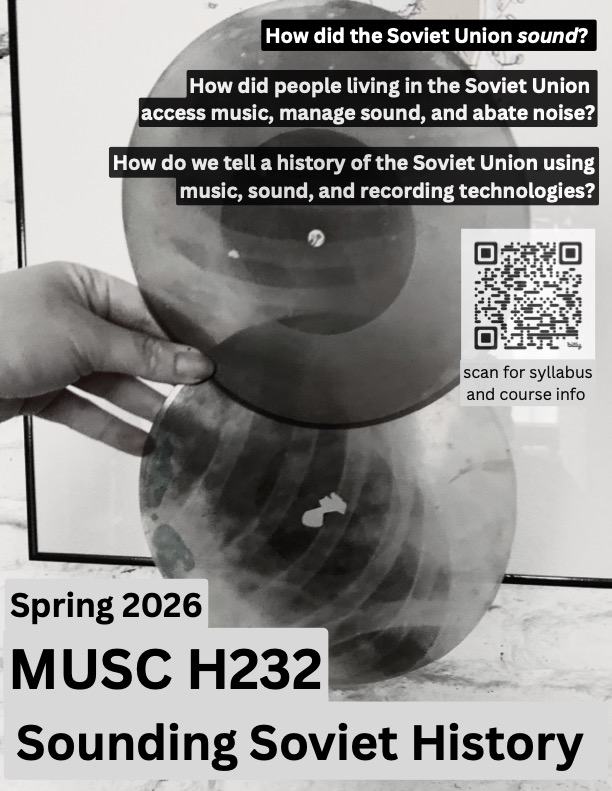
A radio’s hum as a listener tunes it to a state-controlled station, the hiss of static giving way to the jaunty chorus of a song about loyalty to the homeland; a speech by Lenin, heard live in 1919, or heard decades later on a scratchy, plastic disk sold at newsstands, distributed in a magazine; thunderous booms as bombs rain from the sky over Leningrad, buildings toppling in their wake, interspersed with the metronomic tick of an after-hours radio, its quickening tempo warning residents of the next attack; a family’s greeting, recorded over a popular song, intended to be shared with loved ones to convey their best wishes for the new year; celebrities taking the stage for televised pageants to celebrate the “song of the year” as the calendar flips from 1984 to 1985, bringing with it perestroika’s new political order. These are but a few of the noises that comprised the soundscape of the Soviet Union.
This course brings together examples like those above with other remaining sonic traces of the USSR in an attempt to understand how the Soviet Union sounded. To answer this question, this course will chart the history of the Soviet Union, not through a chronology of political leaders and eras, as is typical for Soviet history surveys, but through the music, sound, and recording technologies that defined daily life for Soviet citizens. We will consider the unique contexts of a state-socialist society and how such a system required different modes of circulation. We will think about how people living in the Soviet Union accessed music, managed sound, and abated noise. Among our questions will be how individuals navigated the tension between Soviet state-proliferated culture and personal taste and beliefs. Together, we’ll learn how to use auditory sources to tell a version of the well-versed Soviet historical narrative, read across disciplines (learning about musicological, sound studies, media studies, and historical methods), and work with primary sources to practice using sonic materials to craft an historical argument.
This course brings together examples like those above with other remaining sonic traces of the USSR in an attempt to understand how the Soviet Union sounded. To answer this question, this course will chart the history of the Soviet Union, not through a chronology of political leaders and eras, as is typical for Soviet history surveys, but through the music, sound, and recording technologies that defined daily life for Soviet citizens. We will consider the unique contexts of a state-socialist society and how such a system required different modes of circulation. We will think about how people living in the Soviet Union accessed music, managed sound, and abated noise. Among our questions will be how individuals navigated the tension between Soviet state-proliferated culture and personal taste and beliefs. Together, we’ll learn how to use auditory sources to tell a version of the well-versed Soviet historical narrative, read across disciplines (learning about musicological, sound studies, media studies, and historical methods), and work with primary sources to practice using sonic materials to craft an historical argument.
- Teacher: Allison Brooks-Conrad