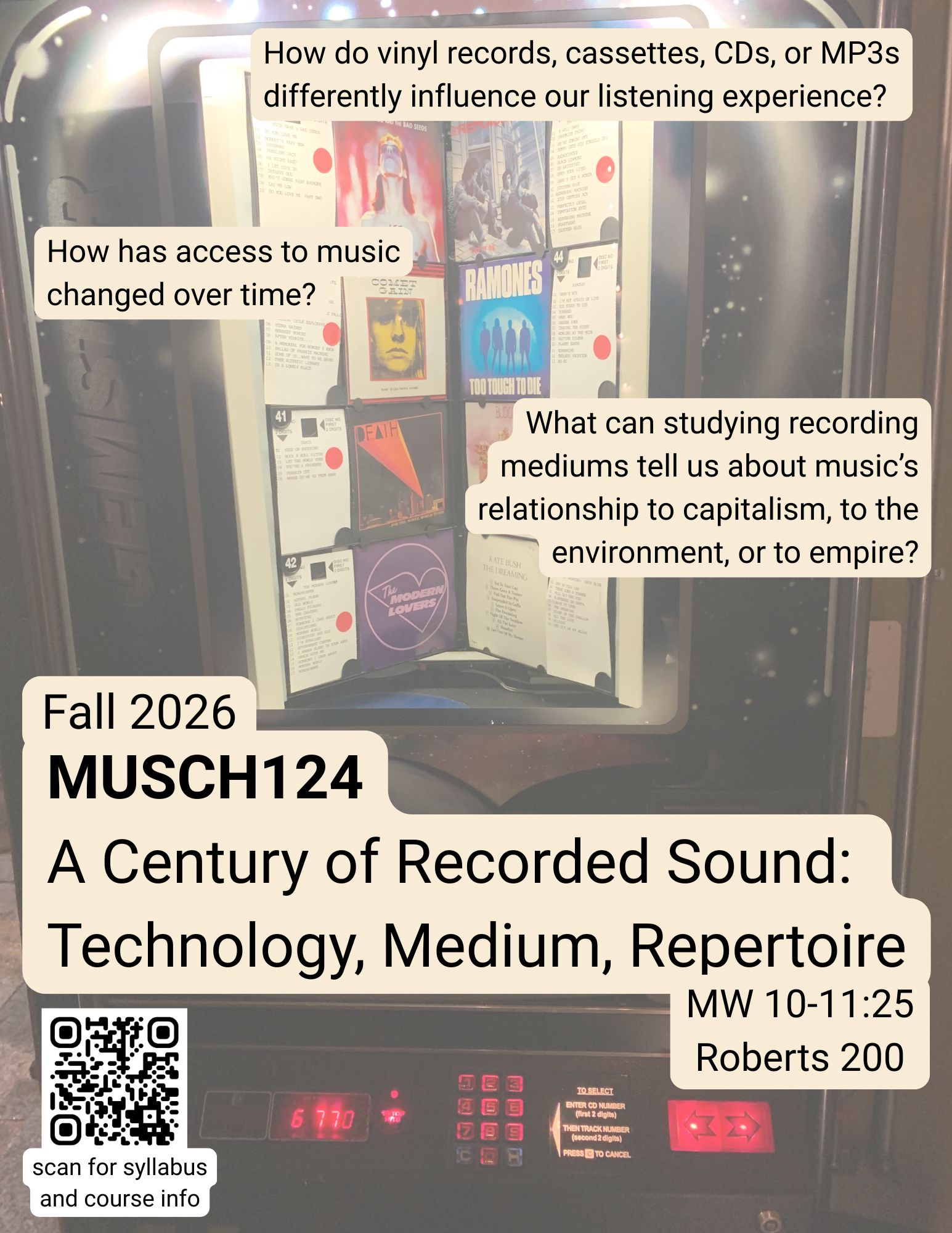
Overwhelmingly, the way most of us encounter music is through recordings, not live performance. But how does that influence the way we experience music? This course is designed as an introduction to thinking critically about the mediums on which music is recorded, distributed, and circulated. The class will provide a chronological overview of recording technologies with an emphasis on the relationship between medium, repertoire, and the experience of the listener, highlighting the unique affordances of different types and styles of recording technologies. After an initial unit during which we will establish shared vocabulary and theory for discussing recorded sound, we will move through a series of units focused on early phonography, radio, vinyl records, bootleg recordings, cassettes, CDs, digital mediums, and more. Readings and case studies are selected to intentionally highlight examples from regions beyond North America and Western Europe. Underlying themes include the environment, questions of genre, and music and capitalism. In addition to short readings (one article or book chapter per class meeting), students will undertake two hands-on projects: one in which they will work with LPs (from the library’s collection) to discuss and analyze these material objects as historical sources, and a hands-on creative project using cassette tapes.
- Trainer/in: Allison Brooks-Conrad
- Trainer/in: Mei-ling Lee
Core concepts and perspectives for the serious study of music. Students will explore music, meaning, and musicological methods in a variety of contexts through a set of foundational themes and questions, including:
• Music and the Idea of Genius
• Who Owns Music?
• Music and Totalitarianism
• Music and Difference
Each unit will use a small number of musical works, performances, or documents as focal points. In each unit we will also read current musicological work in an attempt to understand the methods, arguments, and perspectives through which scholars interpret music and its many meanings. We will encounter a wide range of music from different times and places, from Mozart to Maoist opera, and from minstrel songs to Shostakovich.
- Trainer/in: Allison Brooks-Conrad
- Trainer/in: Ingrid Arauco