Japanese Civilization
EALC 132, Fall 2026
Prof. Hank Glassman
Office: Founders 125
Office hours: Monday 1-3 and by appointment on Zoom
Email: hglassma@haverford.edu
[see appendix for academic support resources, AI policy]
Class: Chase 104 T and TH 11:30-12:50
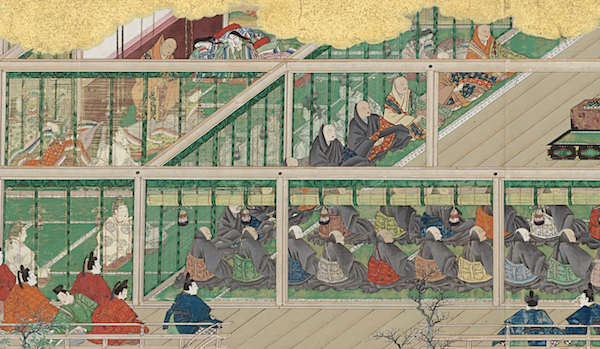
(from “Gio monogatari emaki,” based on Tale of Heike, New York Public Library, early 17th c.)
COURSE DESCRIPTION:
This course will introduce aspects of major historical, social, cultural, and artistic traditions of Japan from circa 1000 BCE (the Jōmon Period 縄文) until present times. We will adopt both chronological and thematic approaches in this inquiry.
Generally, we will consider how Japanese religious, political, and cultural systems developed in and through history. (This is the chronological part!) While this course is a survey and introduces the basic arc of Japanese history, it is not meant to be comprehensive in any way or to tell “the story of Japan” in an unbroken narrative. Instead, we will focus on specific epochs and moments in Japanese history that reflect: the changing status and roles of groups like aristocrats, monastics, warriors, merchants and farmers; the transition from a feudal to a modern society; world war and recovery; natural and manmade disasters; and, the formation of the modern Japanese nation as we know it today.
Additionally, in our study of Japanese civilization we will also engage with six major themes: 1) cultural encounters; 2) national identity; 3) religion; 4) gender; 5) war; and 6) the place of human beings in the natural environment. (This is the thematic part!) Throughout the semester in a variety of contexts, we will examine how these themes express the changing social and political landscape of Japan. We will also use these six themes to engage fundamental questions such as: What is the nation of Japan? Who are the Japanese? For the whole of the twentieth century, intellectuals and cultural leaders in Japan were strongly focused on the idea of “national character” or kokuminsei 国民性. Do you personally think that there such thing as a national character or not? What are the implications if it does exist? Would its origins linguistic or genetic or otherwise?
In addition to offering a chronological/thematic exploration of Japanese history and culture, this course also serves as an introduction to humanistic inquiry more generally and helps students develop basic academic skills that will serve them throughout their college career and beyond. These skills include the ability to identify and use of primary and secondary sources; critical thinking, writing, and looking; and, a facility for expressing ideas orally in front of peers in formal and informal settings. (It is a Domain A course.)
EALC 132, Fall 2026
Prof. Hank Glassman
Office: Founders 125
Office hours: Monday 1-3 and by appointment on Zoom
Email: hglassma@haverford.edu
[see appendix for academic support resources, AI policy]
Class: Chase 104 T and TH 11:30-12:50
(from “Gio monogatari emaki,” based on Tale of Heike, New York Public Library, early 17th c.)
COURSE DESCRIPTION:
This course will introduce aspects of major historical, social, cultural, and artistic traditions of Japan from circa 1000 BCE (the Jōmon Period 縄文) until present times. We will adopt both chronological and thematic approaches in this inquiry.
Generally, we will consider how Japanese religious, political, and cultural systems developed in and through history. (This is the chronological part!) While this course is a survey and introduces the basic arc of Japanese history, it is not meant to be comprehensive in any way or to tell “the story of Japan” in an unbroken narrative. Instead, we will focus on specific epochs and moments in Japanese history that reflect: the changing status and roles of groups like aristocrats, monastics, warriors, merchants and farmers; the transition from a feudal to a modern society; world war and recovery; natural and manmade disasters; and, the formation of the modern Japanese nation as we know it today.
Additionally, in our study of Japanese civilization we will also engage with six major themes: 1) cultural encounters; 2) national identity; 3) religion; 4) gender; 5) war; and 6) the place of human beings in the natural environment. (This is the thematic part!) Throughout the semester in a variety of contexts, we will examine how these themes express the changing social and political landscape of Japan. We will also use these six themes to engage fundamental questions such as: What is the nation of Japan? Who are the Japanese? For the whole of the twentieth century, intellectuals and cultural leaders in Japan were strongly focused on the idea of “national character” or kokuminsei 国民性. Do you personally think that there such thing as a national character or not? What are the implications if it does exist? Would its origins linguistic or genetic or otherwise?
In addition to offering a chronological/thematic exploration of Japanese history and culture, this course also serves as an introduction to humanistic inquiry more generally and helps students develop basic academic skills that will serve them throughout their college career and beyond. These skills include the ability to identify and use of primary and secondary sources; critical thinking, writing, and looking; and, a facility for expressing ideas orally in front of peers in formal and informal settings. (It is a Domain A course.)
- Enseignant: Hank Glassman
- Enseignant: Erin Schoneveld
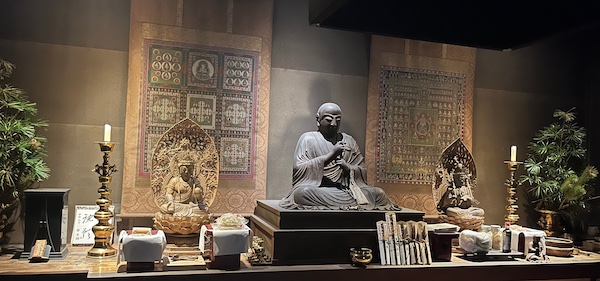
Religion in Japan is, since the start of recorded history and down to the present day, profoundly hybrid and combinatory. (There is a saying that people “are born Shintō and die Buddhist.”) One aim of this course is to challenge the way that students think about the category of religion, both as doctrine and as practice. Much of the material we examine during beginning of the semester will be premodern. In the second half of the course, students may to choose to explore modern and contemporary religion in individual research.
This course is an introduction and assumes no prior knowledge of Japan, East Asia, or of the topic of religion. If you come with some background knowledge, then so much the more you will learn. Either way, there will be things that do not add up or may seem contradictory. This is in part due to the distorting effects of our investigation. This will be OK.
The course takes a thematic approach to examine such topics as deities, pilgrimage, ritual, literature, and doctrine across historical periods to offer a sense of the rich complexity of lived religion. In the first half of the course we will explore a number themes in the history and historiography of Japanese Religion, and in the second half students will take up research, engaging with these themes more deeply.
Two Opening Queries: There are two background questions floating around this course – shadow issues of a sort – not directly related to one another, but both having to with how we manage or curate information and our experience as human beings. One question is the category of “Religion” – what is encompassed by this term? The other is AI as a research tool – where is it helpful and where is it worse than useless? (That is, at this moment in Fall 2026, and with our purposes in mind.) We will talk informally about these two topics in class during the first couple of weeks as we start to form small discussion groups and get to know another. You will each have already had various sorts of exposure to each of these topics of Religion and AI and I feel sure that you have thoughts and opinions to share.
This course is an introduction and assumes no prior knowledge of Japan, East Asia, or of the topic of religion. If you come with some background knowledge, then so much the more you will learn. Either way, there will be things that do not add up or may seem contradictory. This is in part due to the distorting effects of our investigation. This will be OK.
The course takes a thematic approach to examine such topics as deities, pilgrimage, ritual, literature, and doctrine across historical periods to offer a sense of the rich complexity of lived religion. In the first half of the course we will explore a number themes in the history and historiography of Japanese Religion, and in the second half students will take up research, engaging with these themes more deeply.
Two Opening Queries: There are two background questions floating around this course – shadow issues of a sort – not directly related to one another, but both having to with how we manage or curate information and our experience as human beings. One question is the category of “Religion” – what is encompassed by this term? The other is AI as a research tool – where is it helpful and where is it worse than useless? (That is, at this moment in Fall 2026, and with our purposes in mind.) We will talk informally about these two topics in class during the first couple of weeks as we start to form small discussion groups and get to know another. You will each have already had various sorts of exposure to each of these topics of Religion and AI and I feel sure that you have thoughts and opinions to share.
- Enseignant: Hank Glassman