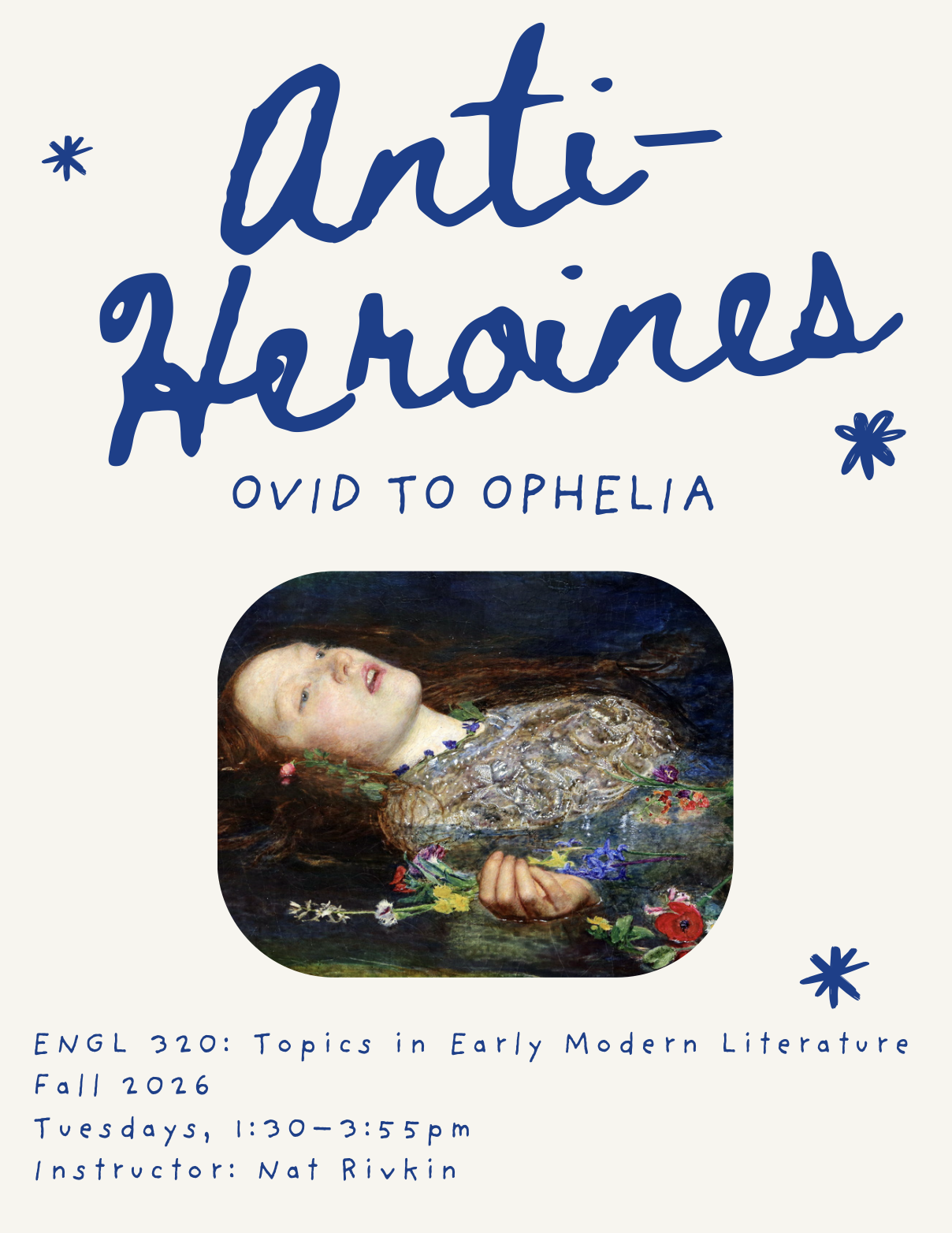
Dido, queen of Carthage, reprimands her fleeing lover Aeneas and invents a pregnancy so that he will stay. Medea, priestess of Hecate, murders her and Jason’s children. Ophelia, a noblewoman of Denmark, goes mad and dies by drowning. Eve, that first woman, bites into the fruit and falls.
This course examines early modern anti-heroines, from their origins in classical antiquity to their resurgence in sixteenth- and seventeenth-century English drama and verse. Our shared goal in this class is to determine what strategies our readings use to condemn, reclaim, or altogether explode unruly femininity. We will examine how women who want more and those who want differently––be they Renaissance poets or protagonists on stage––deploy their writing and speech to new ends. We will discover, for instance, how the earliest woman to publish a collection of poetry in English, Æmelia Lanyer, wrote biblical fan fiction in which Eve speaks back. And we will enjoy the recent afterlives of similar phenomena in, say, Taylor Swift’s adaptation of an early modern script in “The Fate of Ophelia.” Course authors may include Virgil, Ovid, Thomas Dekker and Thomas Middleton, Christopher Marlowe, John Milton, and William Shakespeare. We will draw these texts into conversation with the series Station 11’s dystopian drama troupe and Chloé Zhao’s Oscar-winning biopic Hamnet. Other class topics include girlbosses, madwomen, sorceresses, saints, and thieves.
No previous experience with early modern literature is required. Course assignments include a weekly reading journal, an oral research presentation, in-class writing exercises, a close-reading paper, and a final research project, which can take a variety of critical and creative forms.
This course examines early modern anti-heroines, from their origins in classical antiquity to their resurgence in sixteenth- and seventeenth-century English drama and verse. Our shared goal in this class is to determine what strategies our readings use to condemn, reclaim, or altogether explode unruly femininity. We will examine how women who want more and those who want differently––be they Renaissance poets or protagonists on stage––deploy their writing and speech to new ends. We will discover, for instance, how the earliest woman to publish a collection of poetry in English, Æmelia Lanyer, wrote biblical fan fiction in which Eve speaks back. And we will enjoy the recent afterlives of similar phenomena in, say, Taylor Swift’s adaptation of an early modern script in “The Fate of Ophelia.” Course authors may include Virgil, Ovid, Thomas Dekker and Thomas Middleton, Christopher Marlowe, John Milton, and William Shakespeare. We will draw these texts into conversation with the series Station 11’s dystopian drama troupe and Chloé Zhao’s Oscar-winning biopic Hamnet. Other class topics include girlbosses, madwomen, sorceresses, saints, and thieves.
No previous experience with early modern literature is required. Course assignments include a weekly reading journal, an oral research presentation, in-class writing exercises, a close-reading paper, and a final research project, which can take a variety of critical and creative forms.
- المعلم: Nat Rivkin