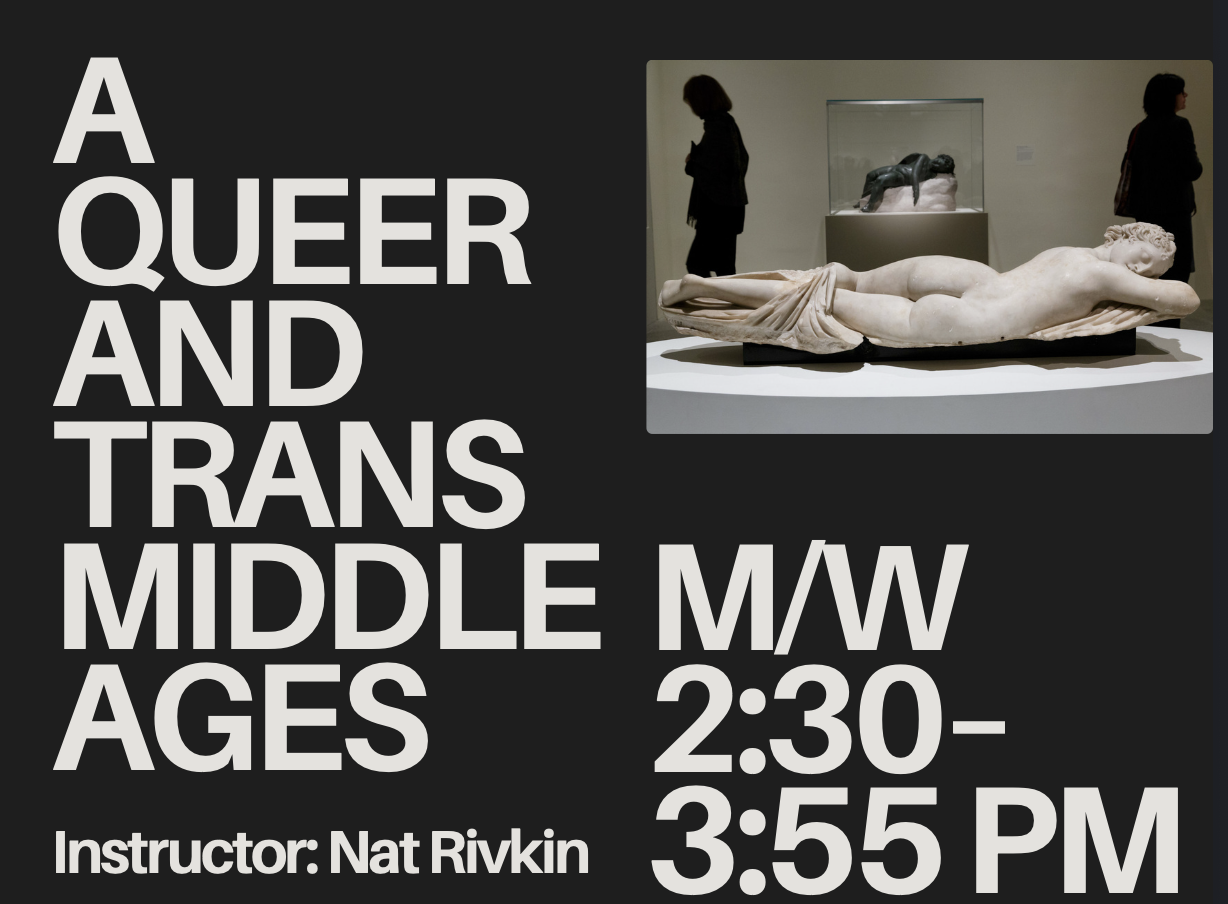
A man takes the form of a hawk and then that of a woman to seduce his imprisoned lover. A knight exchanges kisses with the lady and the lord who host him in the wilderness. A sex worker is accused of shedding her male name and calling herself Eleanor. A martyr disguises herself as a eunuch and adopts masculine pronouns. A lump of flesh is baptized and becomes a white boy.
This course travels across the queer and trans Middle Ages. We will consider how medieval texts––from Arthurian romances to Ovidian myths––both theorize and animate gender, desire, and racial difference. Our shared purpose in this class is to understand how sex and sexuality sustain power, flesh, and faith in Middle English and Old French writing. As we read alliterative verse and mystical prose, we will attend to the strenuous work that literature performs to sanction certain bodies and desires while casting others aside. We will encounter, for instance, monsters at the edges of the world in Mandeville’s Travels and the erotic musings of a woman’s diary in The Book of Margery Kempe. Throughout the semester, we will also engage with scholarship in medieval studies, queer and trans theory, and critical race studies, and we will then practice applying these frameworks to interpret literature. And we will observe how race, class, and ability are tightly bound to the assignment of sex, then and now. Crucially, we will discuss the present-day uses of the straight and cis Middle Ages, which drive dangerous forms of nostalgia. Other possible course topics include angels, daemons, dream visions, werewolves, and witches.
No previous experience with medieval literature is required. We will read all of our texts with facing-page translations or glossaries. Course assignments include a weekly reading journal, an oral research presentation, in-class writing exercises, a close-reading paper, and a final research project.
This course travels across the queer and trans Middle Ages. We will consider how medieval texts––from Arthurian romances to Ovidian myths––both theorize and animate gender, desire, and racial difference. Our shared purpose in this class is to understand how sex and sexuality sustain power, flesh, and faith in Middle English and Old French writing. As we read alliterative verse and mystical prose, we will attend to the strenuous work that literature performs to sanction certain bodies and desires while casting others aside. We will encounter, for instance, monsters at the edges of the world in Mandeville’s Travels and the erotic musings of a woman’s diary in The Book of Margery Kempe. Throughout the semester, we will also engage with scholarship in medieval studies, queer and trans theory, and critical race studies, and we will then practice applying these frameworks to interpret literature. And we will observe how race, class, and ability are tightly bound to the assignment of sex, then and now. Crucially, we will discuss the present-day uses of the straight and cis Middle Ages, which drive dangerous forms of nostalgia. Other possible course topics include angels, daemons, dream visions, werewolves, and witches.
No previous experience with medieval literature is required. We will read all of our texts with facing-page translations or glossaries. Course assignments include a weekly reading journal, an oral research presentation, in-class writing exercises, a close-reading paper, and a final research project.
- المعلم: Danielle Allor
- المعلم: Nat Rivkin